Netflix's Unconscious Confession in Stranger Things
The show warned about a lifeless dimension that devours reality. But it became exactly that — and confessed, without realizing it, in its own animated spin-off.
The Accidental Confession
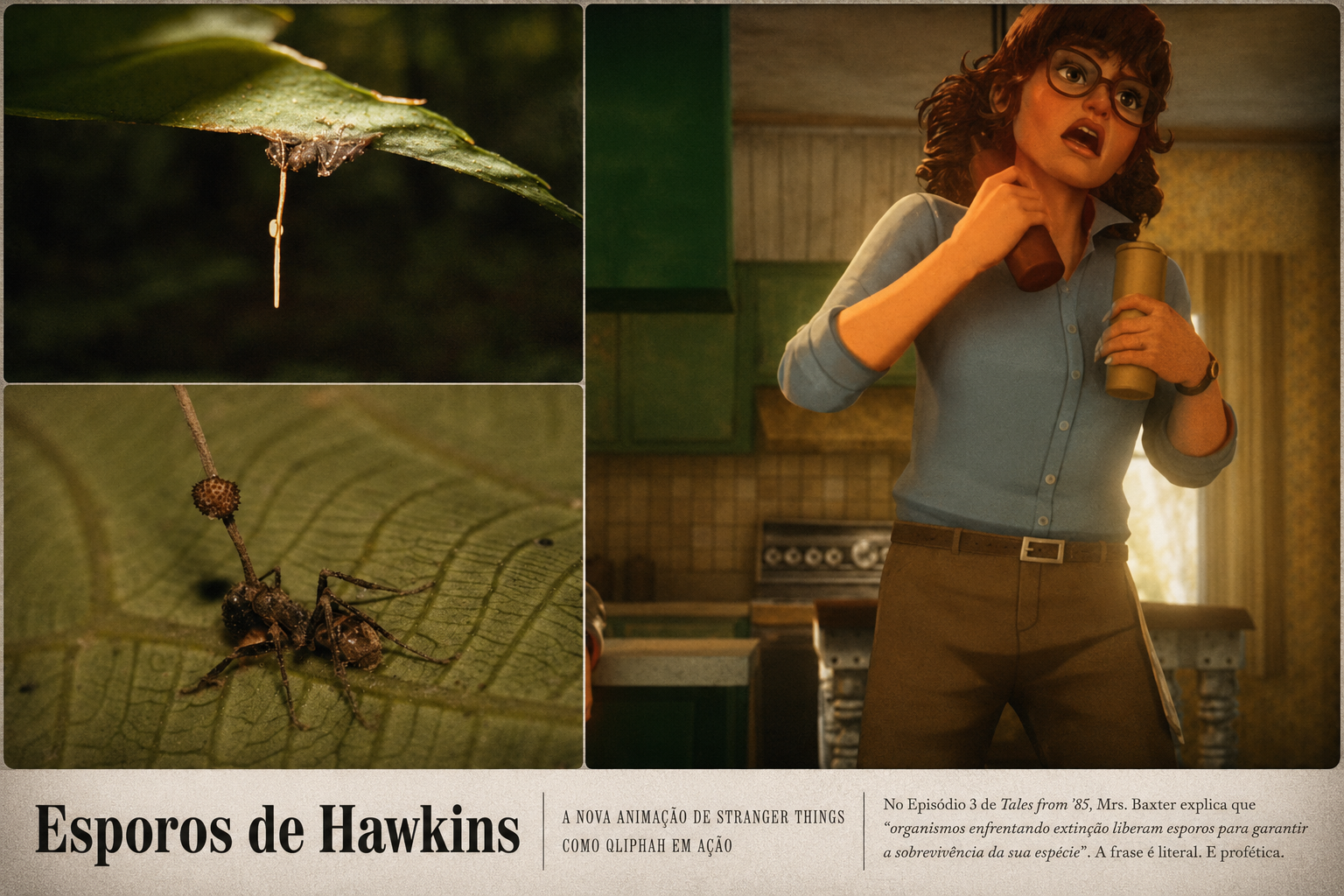
In Episode 3 of the animated series Tales from '85, released in April 2026 with a Happy Meal toy, a new character named Mrs. Baxter — a substitute science teacher — explains to the kids, in a didactic tone, that "organisms facing extinction release spores to ensure the survival of their species."
The line goes by in seconds. It was written by some hired screenwriter, directed by some showrunner, voiced, finalized, and reviewed. No one in the production, I presume, noticed what they had just put in that character's mouth: the literal description of the method by which the animated series itself exists.
Stranger Things ended in its fifth season. It ended badly, but it ended. The animated series, far from being a new work, is a spore released at the death of the original work. It is the residue cast off by a collapsing intellectual property to ensure, as Mrs. Baxter says, the survival of the species.
And there is a name for this mode of existing. It comes from an ancient Hebrew mystical tradition that describes a specific class of entities: shells. Remnants of creation deprived of the divine spark, which cannot live on their own and therefore parasitize the living. The word is Qliphoth.
This essay is about how the Upside Down — presented since the first season as an antagonistic force in Stranger Things — stepped out of fiction and devoured the show. And about how this process, long before it had a Hebrew name, was described by Plato, formalized by Augustine, and replicated, at growing scales, by the very structure of the contemporary culture industry.
I won't deal here with the real experiments that inspired the Hawkins lab, nor with the attention economy that produced the show's narrative collapse. Those points are in the channel's video. The focus here is metaphysical and typological: what the Upside Down is, and why it operates on three levels at once: in the characters, in the institution, and in you.
Shadows and Shells: A Genealogy of the Upside Down
The Upside Down appears in the show as a parallel dimension, accessible through wounds in the fabric of Hawkins's reality. It is a near-perfect copy of the town. Streets, forests, houses, mirrored. The structures remain, but life, color, and warmth have been, as it were, drained away.
The boys, with an intuition the adults have lost, identify the place immediately: it is the Vale of Shadows from Dungeons & Dragons. In Dustin's words: "A dimension that is a dark reflection, or echo, of our world. A place of decay and death." Across the game's various cosmologies (the Great Wheel, the World Axis...) the concept recurs: a necrotic plane, a projected shadow where the light of the higher planes does not reach.
What the children (and the screenwriters) don't know is that this intuition transcends the tabletop game. It is two thousand five hundred years old.
The Shadow's Shadow

In Plato's Republic lies the best-known (and most mishandled) allegory in Western philosophy. Prisoners chained in a cave, seeing only shadows cast on the wall. These shadows are not reality; they are projections of puppets lit by an artificial flame. The puppets, in turn, are imperfect imitations of the real objects that exist outside the cave — real objects that exist under the natural light of the Sun.
The puppets represent the material world, imperfect copies of the eternal Ideas. The Sun represents the Idea of the Good, source of all truth, form, and existence. Everything that is real and good exists because it participates in that light. The perfection of the eternal Ideas — of the reality that exists outside the cave — emanates naturally from the perfection of the Idea of the Good.
The Upside Down is the absolute bottom of that cave. It is what remains when the light of the Good is completely blocked — shadows cast by material reality, lit purely by human artifice. Material reality disconnected from the eternal principles.
The Neoplatonists called this limit-state hyle: pure matter, an ontological residue without form, without unity, without essence. A realm where quantity subsists and quality has vanished. A frighteningly precise metaphysical description of what we see when we cross the portal in Hawkins.
Privatio Boni: Evil as Absence

In late antiquity, a problem tormented philosophers and theologians: how can evil exist in a world created by a good and omnipotent God? If God created everything, and everything He created is good, where does evil come from?
Saint Augustine resolves the question with devastating clarity. Evil is not a substance. God created everything, and everything is good. Therefore, evil has no being of its own.
Evil is privatio boni, the privation of the Good. That which becomes evil when beings such as man, endowed with free will, deliberately turn away from the source of Being, entering a process of continuous dissolution.
Just as darkness is the absence of light, and cold the absence of heat, evil is the absence of the Good. Not a total absence, but a revolt against the good that sustains creation. At bottom, the horror of the Upside Down does not come from what it contains. It comes from what it lacks.
Qliphoth: The Parasitic Shell

The Jewish mystical tradition adds the final piece. In Kabbalah, Qliphoth — literally "shells" — are the residues of creation. Forms deprived of the divine spark. And shells, necessarily, cannot live on their own. They survive by parasitizing what they enclose.
Qliphoth are empty, but hungry. They must attach themselves to living reality in order to suck out its vitality.
Isn't that exactly what the Mind Flayer does in the main series? Or the creatures of the new animated series, sprouting from the spores? They do not create. They colonize, corrupt, drain. The Upside Down does not exist independently. It is one great Qliphoth — a world that exists only by consuming another.
Just as evil only exists by parasitizing a creation that, at bottom, is wholly good.
Hold on to that image. It will be important later.
Hawkins Was Already Empty
The Upside Down does not invade a healthy town. Before the Demogorgon, Hawkins had already been emptied.
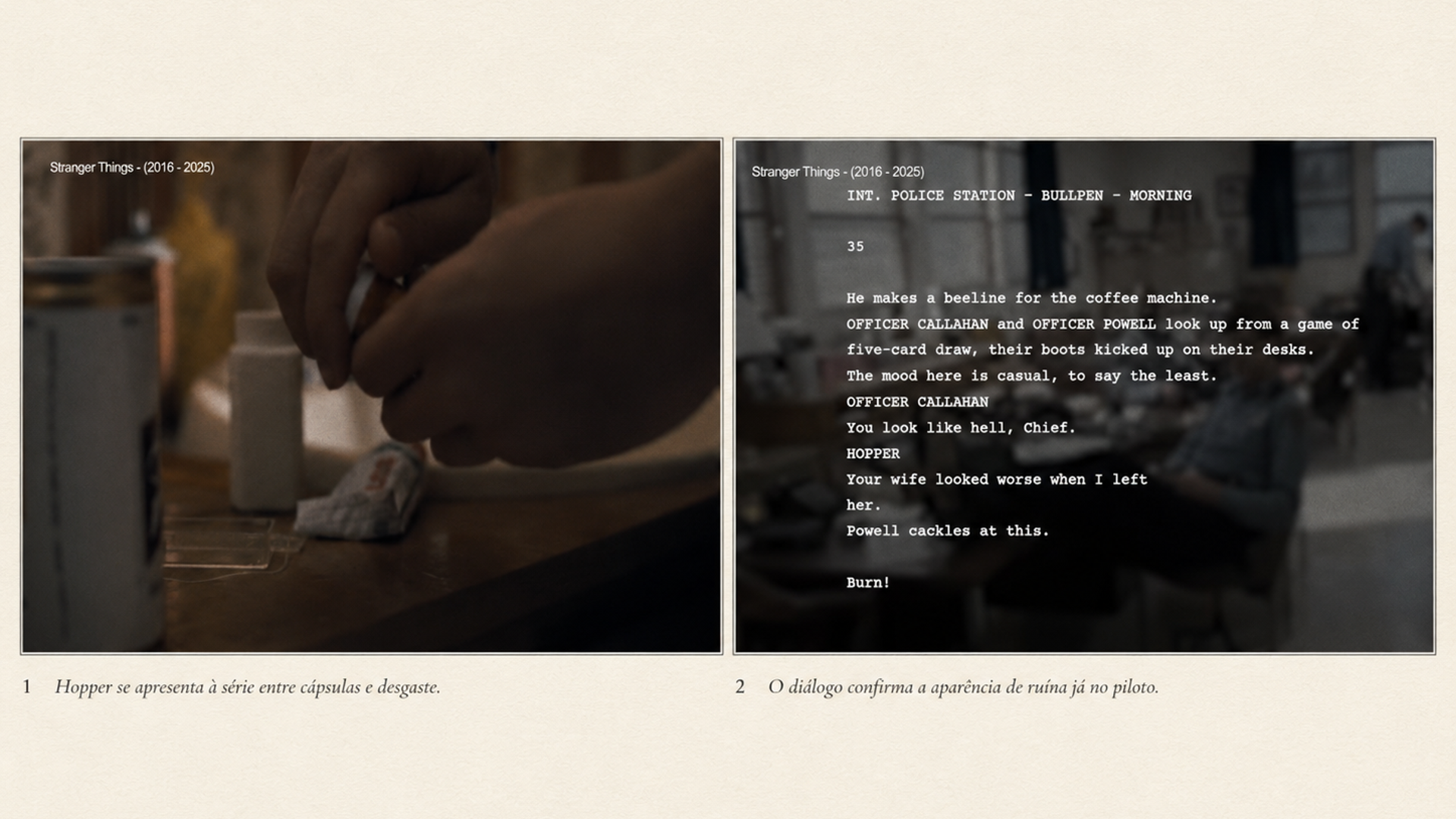
Families are fragmented. The parents, absent. Chief Hopper, in the first season, is a dissolute man, given over to alcohol and barbiturates. His first scene in the pilot literally shows him swallowing Tuinal capsules (a controlled barbiturate in the 1980s) before going to work. His introduction to the series is rounded off by a colleague's remark: "You look like hell, Chief."
Hopper is presented as a shell: a man whose substance has been drained by trauma and whose trauma is chemically anesthetized; a man who still apparently fulfills a social function but merely goes through the motions, never inwardly engaging with his duties and activities, performing them only externally. He is, as it were, the shell of a good detective. Even before the portal opened, Hopper already inhabited his own personal Upside Down.
Adult society lives like the prisoners in the cave: bound to material routine, to consumption, to appearance, with no transcendent horizon whatsoever. And notice a detail that goes unremarked: the show is set in a small town in 1980s rural America and, strangely, religion simply does not exist there. There is virtually no mention of a pastor, a priest, a church, or a prayer.
Think about what that means. God — seen in the Christian worldview as the supreme good, or in Platonic terms as the Idea of the Good from which all eternal Ideas proceed — had been withheld from that community long before the portal opened. Hawkins is a town in a state of aversio a Deo by default. The federal lab merely externalizes, in a concrete experiment, what was already the inner condition of its residents.
The children are the exception. They have not yet been emptied. They see streets as the magical roads of their stories. They perceive the world through the logic of heroism, virtue, and sacrifice. And, not by chance, by immediately identifying the analogies between the real monsters and the ones from fantasy, they acquire the means to deal with the new, real threats.
From the Platonic standpoint, they are closer to reality than the adults, because they still observe things from their essences. They see the invisible through the visible.
And it is precisely this way of seeing that the void of the Upside Down desires to devour.
How to "Empty" a Person

A brief note before moving on. Dr. Brenner's lab is not the screenwriters' invention. It is the fictional echo of a set of real programs such as MKUltra and Stargate, in which the American government spent millions trying to produce, technically and pharmacologically, exactly what Augustine described as the moral movement of aversion to the Good: the emptying of the human person.
The psychiatric term that figures like Ewen Cameron used for the procedure is revealing: depatterning. Erasing the person's pattern. Destroying, with electroshock and drugs, the psychic form of the subject in order to reduce him to a kind of formless shell of himself, available to be remodeled.
Ancient metaphysics had a name for this fifteen hundred years ago. The experimenters of the twentieth century rediscovered the concept without realizing they were merely technologizing an ancient spiritual operation.
The historical details and consequences of these programs are in the channel's video. The only point that matters for this essay is this: the modern technique of emptying works. And what was done in a lab with a few dozen test subjects in the 1950s did not disappear. It migrated.
Three Responses to Evil
Dr. Brenner's lab experimented on a series of children. Some escaped. And in them, the show makes explicit — probably without knowing how much it is saying — three possible responses to the evil suffered. Three anthropological typologies that resonate far beyond Hawkins.
They are perennial positions. They appear in every era in which man finds himself in a fallen creation and has to decide what to do. Stranger Things dramatizes all three simultaneously.
Vecna: The Gnostic Revolt

Vecna, before being a monster, is a wounded child. A Henry Creel who suffered real abuse and trauma. But his response to the trauma is not heroic; it is one of the oldest positions of revolt against being.
Henry concludes that the problem is not the specific evil he suffered. It is existence itself. Being was a mistake. Reality is a prison; the solution is to destroy.
This is the fundamental thesis of Gnosticism in its most radical variants. The material world would be a trap set by a blind or evil demiurge; salvation would come only through annihilation. Vecna takes this to the limit and crosses into explicit cosmic nihilism: he creates the Upside Down as an instrument of active devouring. It is not merely to flee matter; it is to make matter disappear.
Vecna is, in this scheme, a perfect anti-Christ. Where Christ redeems the world by accepting the suffering that comes from evil, resignifying it and sanctifying it, Vecna proposes redemption as annihilation. Where the Christian kenosis is a self-emptying done out of love, Vecna's kenosis is a self-emptying of love itself.
The contemporary version of Vecna writes books on antinatalism, essays on nihilist accelerationism, manifestos on the error of consciousness. Different terminology, same structure: the problem is Being, and the solution is less Being.
Eleven: The Sacrificial Response
Eleven wavers. She has moments of violence, of fear, of paralysis. At her best, however, she finds the Good in friendship, in care, in the sacrifice that transcends her.
Her response to trauma is not to deny the world; it is to protect the world — even if she herself is sacrificed in the process. She reabsorbs the adverse circumstance and, out of the evil she suffered, through the good use of the powers that evil imposed on her, tries to draw a greater good.
This is the archetypal Christian position. Evil exists and the world is fallen, but the response is not to flee Being; it is to give oneself up for It. It is, out of love for the good, to become the good even in the most hostile circumstances. The logic is that of the martyr: suffering is real, but it can be converted into a greater good if it is ordered by love.
And here there is an important metaphysical intuition, which appears in an almost theological form in the show: if the suffering is suffered for a good high enough, it is better to suffer for that good than not to suffer and never attain it.
The scene in which Eleven, in the second season, meets Kali and briefly considers entering her path makes this maximally explicit. Eleven feels the seduction of personal power, of revenge against her tormentors. And she refuses. Not because she is stronger, but because she intuits, without articulating it, that revenge does not heal. That entering the game of evil leads to dissolution through the rule of the game that this very evil imposes.
When she returns to Hopper, to Mike, to her friends, she is not running away from Kali. She is choosing kenosis over power. She is choosing Christ over Vecna and over Kali at the same time.
The sacrificial response is, of the three, the only one that defeats the dynamic of the Upside Down, because it is the only one that does not operate by the logic of privation, but by the logic of the gift — of the giving (in the most primordial sense).
The numerical symbolism is also worth noting. In Pythagoreanism, 1 is the principle, and 10 is the expression of perfection, or the "totality of the cosmos," for being the fourth triangular number (the Tetractys: 1+2+3+4).
The number 11, by exceeding the decade, figures the transgression of totality — a sense the Christian tradition radicalizes: Saint Augustine, reading figures of the Old Testament, sees it as the "transgression of the Decalogue." But 11 is also the first number after consummated totality — a new beginning. Eleven, subject number 11 of Brenner's experiments, embodies both poles: she transgresses not the true order, but the false totality imposed by the lab; by breaking the logic of dissolution, she ceases to be the sin that exceeds the law and becomes the new beginning that redeems, through sacrifice, what had been caused by her.
Kali: Revolt Playing by Evil's Rules
Kali (008) is the most underestimated character in the series. Underestimated because her position is the most common — and the hardest to identify as an error within secular logic.
Kali does not want to destroy Being, as Vecna does. But neither does she reabsorb the adverse circumstance, as Eleven does. She does the third thing: she uses the powers evil imposed on her for her own benefit, in an amoral and marginal way, to impose her will on the world and to exact, at any cost, her revenge.
She accepts the rules of evil's game and tries to win within them, causing lesser evils in the name of seemingly just ends. This is, in practical political terms, the basic structure of every modern revolution: to accept the existing power scheme and try to invert who occupies each position, attempting to seize the positions of power.
The problem is that the rules of the game are already rigged against whoever enters. The Upside Down has its own "physics," the physics of parasitic privation, and whoever agrees to fight by those rules is, sooner or later, dissolved by them. Kali, in the end, defeats no one. She becomes herself a profane echo of the Hindu goddess whose name she carries — a figure associated with destruction as supposed liberation, but who, outside the original sacred context, operates only as a particular, self-absorbed entropy.
The contemporary version of Kali is everywhere. She is the activist who reproduces the evil he claims to fight. She is the cultural critic who becomes a servant of what he criticizes. She is the entertainment company that sees the emptying of the modern viewer and responds with more emptied-out production.
Hold on to this figure as well. Netflix will become Kali in the next section.
Netflix Becomes Kali
Here is where we leave the analysis of the characters and enter the analysis of Netflix itself, which embodies, without realizing it, the position of Kali.
Consider the operation. Stranger Things is born at the moment Netflix begins experimenting with series algorithmically calculated for specific demographic profiles. The calculation identifies that 1980s elements produce nostalgia in a specific band of subscribers. The series is commissioned and shaped by that marketing algorithm.
The first two seasons have genuine merits — probably because the Duffer Brothers and the team were still people who loved those references. The calculation was the frame, but the content was human. The original sin, however, was there: the work was not born to tell a story or to communicate a truth that transcended it. It was born to retain, algorithmically.
From the third season on, the frame swallows the content. The commercial partnerships explode. The script becomes a vehicle for brand placement. The Starcourt Mall is set and storefront simultaneously. In the fourth, executives begin demanding expository dialogue for distracted viewers, and the characters stop conversing in order to announce. In the fifth, the degradation is terminal.
The details of this collapse — how many brands, which executives, which specific decisions, and the explicit account of the script's degradation — are in the channel's video.
Netflix could have responded to the emptying of the modern viewer in three ways. Let us see.
The "Vecnist" response: to identify the entertainment industry as the problem and abandon it, or try to destroy it along with the entire market and all cultural production. No corporation does this, and for good reason — it would be suicide. But it would be a coherent position.
The sacrificial response: to make works with a vocation for truth even knowing that, at first, they will not be as appealing or as viral. To accept the risk of quarterly losses in the name of something greater than the quarter. To operate by the model of the gift, not of extraction. Or, as an "intermediary," to use the preferences discovered by the algorithm in order to point, through them, toward something that transcends them.
Kali's response: to accept the rules of the attention market and try to win within them using the instruments of emptying — to produce more and more, not according to the essence of the work, but according to market trends, even if the trends — in exchange for profit — destroy what the work is.
Netflix chose the third.
Stranger Things warned, in fiction, about a lifeless dimension that devours material reality. Netflix, by processing the series through the algorithm, turned the series itself into a Qliphoth — a shiny, expensive, empty shell that exists by parasitizing what it once was.
The work, in dying, released spores. And here we return to Mrs. Baxter.
The Spore: The Unconscious Confession
The animated series Tales from '85 is the most perfect confession this logic could have produced — made within the fiction itself, without anyone in the production, by all indications, having noticed.
Strategic positioning: the animated series is set between the second and third seasons. Exactly the last window in which the show could be called art, before the algorithmic-financial corruption took over. They returned to the point of greatest vitality in the plot in order to parasitize it.
And the confession appears at three levels in the product.
In the dialogue: Mrs. Baxter explaining spores. Organisms facing extinction release spores to ensure the survival of the species. The method by which the animated series exists is literally described — Stranger Things died in season 5, and right afterward it released a spore: an animated series, a Happy Meal toy, a film announcement, an announcement of more animation.
In the villain: Daniel Fischer, a former employee of Brenner's lab, a supermarket owner, running clandestine experiments at home to create a new monster that brings the Upside Down back. The Qliphoth could not invent a new villain. It repackaged Brenner on a smaller scale. And the detail that ties it all together: Fischer cannot even be evil on his own merit. He steals his own wife's scientific research to fabricate the creature. Even the vitality of evil has to be parasitized from someone else's source.
In the post-credits: Episode 10 ends with a blue flower sprouting from the remains of the dead monster. An explicit setup for the next return. Because in the logic of this product, the monster can never truly die. If it dies, the next season has no reason to exist.
Critics around it perceived the diagnosis — though without the metaphysical vocabulary to name it. Variety published a review defining the animated series as a "transparent attempt to preserve Stranger Things in pixels rather than in amber, allowing Netflix to keep capitalizing on the phenomenon even after its original faces have moved on to other projects."
Further on in the same piece, the critic adds that Netflix "can continue to mine this intellectual property for as long as its audience desires." And it defines the product, in another passage, as "nostalgia for nostalgia, in a recursive loop, with predictably diminished impact."
It is, in secular vocabulary, exactly the diagnosis of this essay. A shiny shell, parasitizing someone else's vitality, releasing spores to survive its own extinction. Qliphoth, in other words.
The Light Has Not Gone Out
The metaphysical principles of the Upside Down (matter without spirit, copy without soul, parasitic hunger) stepped off the screen and consumed the production. Stranger Things did not go bad by accident. It was generated by the calculation and devoured by the reason that produced the calculation. The work that warned about dissolution became an agent of dissolution.
And here the typology closes.
Vecna refuses Being. Eleven gives herself up for It. Kali tries to win within evil's rules and is dissolved by them. Each position operates on the plane of the characters. Each position also operates on the plane of institutions. And each one operates, finally, on the plane of whoever is reading this right now.
You have the three options before the emptying of the contemporary culture industry. You can refuse Being and plunge into cultural nihilism — declare everything lost, everything simulacrum, everything slop, and abandon the act of seeking truth in what you consume. That is Vecnism applied to criticism.
You can accept the rules of the algorithm and try to win within them — consume the product, post the reactive opinion, feed the retention machinery in exchange for small personal hits of dopamine. That is Kalism applied to daily life.
Or you can do the hardest thing: receive what truly exists in the world, refuse what is mere shell and falsehood, and give your attention as an act of donation to what deserves to be. It is the only response that does not reproduce, on an individual scale, the Qliphoth.
The Upside Down of the real world is not a preternatural realm. It is the algorithmic method that dissolves substance in order to sell simulacra. And it will not stop as long as there are hosts.
The question that remains is not whether you will watch the next season. It is whether you can still distinguish between a story and a shiny shell that passes itself off as a story.
And for those who think of blaming generative AI for all the present decadence and the decadence to come: not all slop is made by AI. The human screenwriters of the fifth season and of the animated series produced spreadsheet-motivated content without needing any language model at all. AI is not the cause of the problem. It is merely the latest delivery boy of a production model that had been industrializing emptiness for decades. When AI arrives to write the next script, it will have nothing to corrupt that has not already been corrupted by the human hand surrendered to the algorithm before it.
But that is a subject for another text.
If this essay made sense, consider subscribing. I write here about what most cultural criticism cannot see because it has lost the vocabulary to see. If you know someone who still watches television — or who is about to blame AI for what the human industry was already doing decades ago — share it.
There is a video version of this argument, with a greater focus on the sociopolitical and economic side of the "Upside Down" — the real CIA experiments, Silicon Valley's algorithmic engineering, and the specific case of how Stranger Things was processed by Netflix's retention machine. It is here on the channel.